
Why A Skip Trace Is Different From A Background Check explains how Skip Tracing Pensacola finds people and background checks verify information.
You have someone’s name, an old address, and perhaps a phone number that no longer works. Maybe you need to serve legal documents, locate a witness, reconnect with someone involved in an important matter, or verify information about a potential business partner. You begin searching online, and two services keep appearing: skip tracing and background checks. They sound similar, and both involve investigating people, but they do not necessarily answer the same questions.
A skip trace is primarily designed to help locate someone. A background check is generally designed to examine information about a person’s identity, history, qualifications, or other relevant circumstances. Both may involve public records, research databases, and investigative verification, but the purpose of the assignment determines what information is useful and how it should be obtained.
For attorneys, businesses, and individuals considering Skip Tracing Pensacola, understanding the distinction can save time and prevent paying for information that does not solve the actual problem. At Sunbelt Investigative Services Group, our investigative services support clients who need reliable answers, whether that involves developing a current location, evaluating background information, or determining which investigative approach is appropriate for a particular matter.
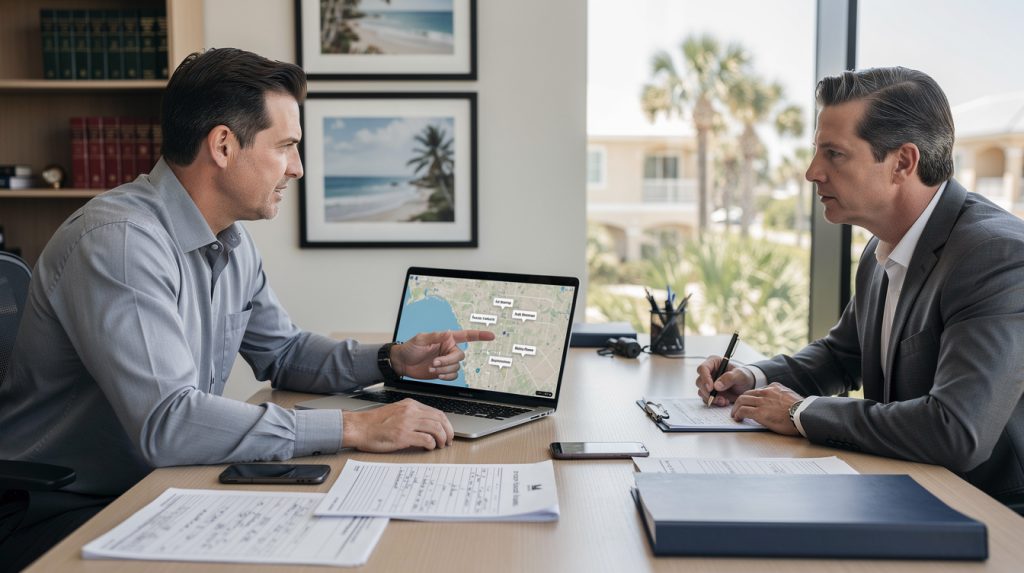
The simplest way to understand skip tracing is to think about the question it is intended to answer: Where can this person currently be located?
Someone may have moved several times, changed phone numbers, relocated for employment, stopped responding to correspondence, or disappeared from an address that was previously reliable. The client may know who the person is but no longer know how to reach them.
Professional skip tracing involves reviewing identifying information, address histories, publicly available records, business connections, and other lawful investigative resources to develop useful location leads. The objective is not necessarily to produce a complete account of someone’s life. It is to determine which available information may help locate the correct person.
For example, an attorney may have a defendant’s full name and last known address from a contract signed three years earlier. The address may still appear in online directories, but a process server discovers that the defendant no longer lives there. A skip-tracing investigation may help identify a more recent address, current business connection, or other information that supports the next lawful step.
This is why Skip Tracing Pensacola is frequently useful in process service, witness location, civil litigation, asset-related investigations, and other matters where finding the individual is the immediate priority.
A background check generally focuses on establishing or verifying information about a person rather than simply determining their present location. Depending on its purpose and lawful scope, a background investigation may examine identity, employment history, professional credentials, relevant public records, business affiliations, litigation history, or other information connected to a specific decision or investigation.
For example, a business considering a relationship with a potential partner may want to verify that person’s business experience, professional background, and publicly documented connections. An attorney may need to understand information relevant to a witness. An organization conducting employment screening may need a properly authorized background report that meets applicable federal and state requirements.
These assignments are not identical, and the law governing the information can differ significantly depending on the purpose.
A background check is therefore not simply a deeper version of skip tracing. It is an investigation with a different objective. While locating someone may be part of the work, the primary purpose is often to evaluate or verify relevant background information.
Skip tracing and background investigations can use overlapping research methods. Both may involve reviewing public records, comparing identifying details, researching business affiliations, and examining available information about an individual.
That overlap can create confusion, especially when commercial websites advertise people searches, address searches, criminal-record searches, and background checks as though they are interchangeable.
A search platform may produce a list of old addresses, possible relatives, business connections, and public-record references under one person’s name. The information may look comprehensive, but it does not necessarily establish either the person’s current location or the accuracy of their background.
Professional investigation requires more than collecting a large volume of data. It requires determining what the client needs to know, whether the information is legally available for that purpose, how reliable it appears, and what additional verification may be necessary.
The distinction becomes especially important when the client intends to use the information in litigation, employment, business decisions, or another matter with significant consequences.
One of the most common situations requiring skip tracing begins with an unsuccessful attempt to serve legal documents.
An attorney provides an address that appears reliable. The process server arrives, but the property is vacant or occupied by someone unrelated to the defendant. A resident may report that the individual moved months earlier. The original address may have been accurate when the case began but is no longer useful.
At that point, the immediate problem is not understanding the defendant’s entire history. It is developing a reliable location lead.
Professional Skip Tracing Pensacola can help investigate whether more recent information is available through lawful records and research. The findings may support another service attempt, identify an alternate location, or help the attorney determine whether additional steps are necessary.
Florida’s service-of-process laws establish requirements for different forms of service, including personal and certain substituted service procedures. Those rules make accurate location information particularly important because sending a process server to an incorrect address can waste time without advancing the legal matter.
Consider a different situation involving a Pensacola business owner planning to enter a significant partnership with someone they have recently met. The prospective partner provides a detailed professional history, describes several previous companies, and claims to have experience managing large commercial projects.
The business owner may already know where the individual lives and works. Location is not the problem. The concern is whether the information being presented is accurate.
A properly scoped background investigation may help verify public business registrations, relevant professional licenses, litigation history, prior company affiliations, and other legally accessible information.
The investigation may confirm the person’s representations, identify discrepancies that need clarification, or reveal additional context relevant to the business decision.
That is a fundamentally different objective from skip tracing. The business owner is trying to evaluate information, not locate someone whose whereabouts are unknown.
An address history is often one of the most useful starting points when someone becomes difficult to find. However, the challenge is rarely a complete absence of addresses. Instead, there may be too many possible addresses, and several may be outdated.
A subject may have lived in Pensacola, moved to Mobile, maintained a mailing address in another city, and later registered a business elsewhere. Commercial records may continue connecting the person to all of these locations.
An investigator must determine which leads appear current and which may represent historical connections. Property records, business registrations, lawful public information, and other available details can help establish a more accurate timeline.
The strongest lead is not always the address appearing at the top of a database result. It is the one supported by the most reliable current information.
This verification process is one of the reasons professional Skip Tracing Pensacola can provide more meaningful results than a casual online search.
While skip tracing concentrates on locating a person, a background investigation may explore several categories of information depending on the assignment’s purpose.
A business-related investigation may focus on company ownership, professional licensing, prior business affiliations, court records, and publicly documented disputes. An investigation supporting litigation may examine records and associations relevant to the legal questions involved. An employment background check may involve qualifications, employment history, criminal-history information, or other permitted screening categories.
However, access to information is not unlimited simply because the assignment is called a background check.
Different sources have different legal restrictions. Employment screening, credit reports, consumer reports, medical information, and certain other records are subject to specific laws and conditions.
A professional investigator should therefore establish the purpose and authorized scope before beginning the work.
Online people-search services can make locating someone appear deceptively simple. A user enters a name, selects a state, and receives a collection of possible addresses, phone numbers, relatives, and public records.
Those results may provide leads, but they can also be misleading.
An address may belong to a former roommate. A phone number may have been reassigned. Two people with similar names may be confused. A recently updated webpage may still contain records collected years earlier.
Professional skip tracing involves evaluating those issues instead of treating every result as confirmed information.
An investigator may compare identifying details, examine the history of available records, assess how recent the information appears, and determine whether additional lawful verification is appropriate.
This distinction matters when the client needs reliable information for something more consequential than curiosity.
Finding the correct individual can become difficult when several people share a common name.
Imagine searching for someone named Michael Johnson in Northwest Florida. There may be numerous individuals with that name living in Pensacola, Milton, Pace, Navarre, or nearby communities.
Without additional identifying information, a database search may produce several plausible but incorrect results.
Details such as a middle name, approximate age, date of birth, former employer, previous address, known business, or related information may help distinguish the correct individual.
Professional Skip Tracing Pensacola should prioritize accurate identification before treating a location as a reliable lead. Locating the wrong person can create unnecessary expense, privacy problems, and confusion for everyone involved.
The same principle applies to background investigations. Records belonging to another individual should never be presented as though they establish facts about the person being investigated.
Yes. Witness location is one reason attorneys may need investigative assistance.
A person may have witnessed an accident, business incident, property dispute, or other event several years earlier. Their testimony or statement may still be relevant, but the contact information in the case file is no longer current.
The witness may have changed employers, moved to another state, or stopped using the phone number originally provided.
Skip tracing can help develop location leads that allow the legal team to determine how to make appropriate contact.
The investigation should be conducted lawfully and with respect for privacy. Locating someone does not automatically mean the investigator has authority to access restricted records, impersonate others, or use intrusive methods.
A carefully documented location investigation can make an important difference when a case depends on information from a witness who has become difficult to reach.
Businesses may request background investigations for many reasons, including evaluating potential partners, verifying business relationships, reviewing certain transactions, or investigating suspected misconduct.
The appropriate scope depends on the business purpose and applicable laws.
For example, a company considering a substantial contract may need to verify public corporate records and relevant ownership information. An attorney advising on a transaction may require additional due diligence. An organization responding to suspected internal misconduct may need factual research connected to a defined allegation.
These investigations should not be treated as unrestricted access to someone’s personal life.
A professional background investigation is most useful when the questions are specific and the information gathered is relevant, accurate, and obtained through lawful means.
A particularly important distinction involves employment background screening.
When employers use certain third-party background reports to make hiring, promotion, reassignment, retention, or other employment decisions, the Fair Credit Reporting Act may apply. The law establishes obligations involving permissible purposes, notice, authorization, accuracy, and procedures before certain adverse employment decisions.
The Federal Trade Commission explains that employers obtaining background information from companies that compile consumer reports generally must provide appropriate disclosure and obtain written permission before procuring the report for employment purposes.
This means a business should not assume that any investigator’s general background research can automatically substitute for a compliant employment-screening report.
A client should clearly explain whether the information will be used for employment, litigation, business due diligence, or another purpose so the appropriate legal requirements can be evaluated.
The Fair Credit Reporting Act governs access to consumer reports, including reports used for certain employment, credit, housing, insurance, and other legally permitted purposes.
A person cannot obtain a consumer report simply because they are curious about someone else’s finances or history.
The Consumer Financial Protection Bureau emphasizes that obtaining or using consumer reports requires a legally permissible purpose.
This distinction is particularly important because people sometimes confuse having a legitimate interest in locating someone with having authority to obtain their credit report or other restricted consumer information.
Those are not the same thing.
Skip tracing does not automatically authorize access to credit reports, protected financial information, private communications, or other restricted records.
Not necessarily. The primary objective of a skip trace is location.
A researcher may encounter public court information while developing leads, but that does not mean the resulting skip-tracing report is a comprehensive criminal-background investigation.
Criminal-history searches can involve different jurisdictions, record systems, reporting restrictions, and identification requirements. A person may also have a common name that creates a risk of confusing records belonging to different individuals.
When criminal-background information is relevant to an authorized assignment, the investigation should be scoped appropriately and the information evaluated carefully.
Clients should not assume that obtaining a current address automatically provides a complete understanding of someone’s criminal, employment, financial, or business history.
Florida regulates private investigative agencies and investigators under Chapter 493 of the Florida Statutes.
The Florida Department of Agriculture and Consumer Services oversees licensing for individuals and companies providing regulated private investigative services.
Florida Statute 493.6101 defines private investigation broadly enough to include obtaining information about the identity, habits, conduct, movements, whereabouts, affiliations, associations, transactions, and other relevant matters involving individuals or organizations.
This framework helps explain why both skip tracing and background investigations may fall within professional investigative work, even though the assignments serve different purposes.
Working with a properly licensed investigative agency provides clients with an identifiable professional provider operating within Florida’s regulatory framework.
Yes. The two services can overlap when information developed during one investigation creates a legitimate need for another.
For example, an attorney may initially need to locate someone for process service. During the research, the investigator may identify several business affiliations that appear relevant to the underlying legal dispute.
If the attorney authorizes additional work and it can be performed lawfully, the assignment may expand into relevant background research.
Similarly, a business background investigation may reveal that a person has provided outdated contact information, creating a separate need for location verification.
However, expanding the scope should be deliberate. Information collected for one purpose should not automatically be used for unrelated purposes without considering legal restrictions and the client’s authorization.
The goal is to provide the right investigative service for the actual problem.
If your immediate problem is that someone no longer lives at the address you have, skip tracing is generally the more relevant starting point.
An attorney trying to serve a defendant, a business seeking a witness connected to litigation, or a client attempting to locate someone for a legitimate matter will usually benefit more from current-location research than from a broad background report.
However, the precise approach depends on the facts.
If you also need to verify the person’s identity, business connections, or other relevant background information, the investigator can help determine whether a separate investigation is appropriate.
Choosing the right service at the beginning can keep the assignment focused and avoid unnecessary research.
When the primary concern involves understanding a potential partner’s history or verifying representations, a background or due-diligence investigation is usually more appropriate.
The company may want to confirm business registrations, professional credentials, disclosed affiliations, litigation history, or other relevant matters before entering a significant agreement.
Simply locating the person’s current residence does not answer those questions.
A background investigation may also reveal discrepancies requiring clarification, although findings should not be treated as proof of misconduct without appropriate supporting evidence.
Sunbelt Investigative Services Group provides investigative support that can help businesses and attorneys develop information relevant to important decisions.
Skip tracing and background investigations can involve personal information, sensitive legal matters, business disputes, or confidential client concerns.
That makes discretion essential.
A location investigation may involve someone connected to pending litigation. A background investigation may involve allegations that have not been established. Information may be incomplete or subject to restrictions on disclosure.
Investigators should therefore maintain appropriate confidentiality, document relevant sources, and avoid sharing findings with unauthorized parties.
Clients also have responsibilities. Information should be requested for lawful purposes and used consistently with applicable privacy and reporting requirements.
Professional investigation should provide clarity without creating unnecessary exposure for the client or the person being researched.
A professional skip trace may be worth considering when the address you have repeatedly produces no useful result, the person has moved without providing updated contact information, a process server cannot complete an assignment, or a witness needed for litigation has become difficult to locate.
You may also need assistance when several possible addresses appear online and you cannot determine which one is current.
The sooner reliable identifying information is gathered, the easier it may be to establish a useful search direction.
Waiting does not automatically make someone impossible to locate, but older records may become less useful as people continue moving, changing jobs, and updating contact information.
Sunbelt Investigative Services Group provides professional investigative services for attorneys, businesses, and private clients who need reliable information for legitimate purposes.
Our services include skip tracing, background investigations, process service, and other investigative support. This combination is particularly valuable when a location problem is connected to litigation, witness research, or a broader investigation.
Professional Skip Tracing Pensacola should not simply produce a list of possible addresses without context. It should focus on identifying the correct individual, evaluating available information, and developing useful leads that support the client’s next lawful step.
Likewise, background investigations should be conducted with a clearly defined objective and attention to accuracy, confidentiality, and applicable legal requirements.
Our goal is to help clients understand which service best fits their circumstances rather than treating every investigative request as though it requires the same solution.
Skip tracing focuses primarily on locating someone or developing current contact and address leads. A background check focuses on examining or verifying information about a person’s history, identity, qualifications, or other matters relevant to a particular purpose.
It may include address-related information, depending on the type and purpose of the investigation. However, a background check is not necessarily designed to verify a person’s current location. Skip tracing is usually more focused on that objective.
Potentially, yes. Investigators may use lawful research methods to develop leads involving people who have relocated between states.
A properly licensed private investigator may provide both skip tracing and background investigative services within the scope of applicable law, authorization, and professional capabilities.
No. Skip tracing is primarily a location investigation, while a criminal-background check focuses on legally accessible criminal-history information relevant to an authorized purpose.
You should consider hiring a private investigator when important decisions depend on facts you do not currently have, or when you need professional help gathering evidence, locating people, verifying claims, or documenting activity.
Yes. Private investigators frequently support attorneys with witness location, witness statements, surveillance, criminal defense investigations, civil investigations, asset searches, and litigation support.
Yes. Private investigators can assist businesses with employee theft, fraud, workplace misconduct, vendor issues, background investigations, and corporate risk concerns.
Yes. Professional investigators handle inquiries and investigations with discretion and confidentiality.
No. A confidential consultation can help determine which investigative service best fits your situation.
Some questions are too important to leave unanswered.
Why A Skip Trace Is Different From A Background Check comes down to the question the client needs answered. If the problem is that someone has moved, disappeared from a known address, or become difficult to locate, skip tracing is generally the more focused investigative service. If the problem involves verifying someone’s history, business affiliations, qualifications, or other relevant information, a background investigation may be the better starting point.
Both services require more than simply downloading information from a website. Useful investigative work involves identifying the correct person, evaluating available sources, verifying important details, respecting legal restrictions, and reporting findings accurately.
For attorneys handling litigation, businesses evaluating important relationships, and individuals facing legitimate location challenges, understanding this distinction can save time and help direct resources toward the right solution.
If you need Skip Tracing Pensacola or professional background investigative support, contact Sunbelt Investigative Services Group at (850) 687-3510 for a confidential consultation.
Contact us today for a confidential consultation and let’s discuss the right investigative approach for your situation.